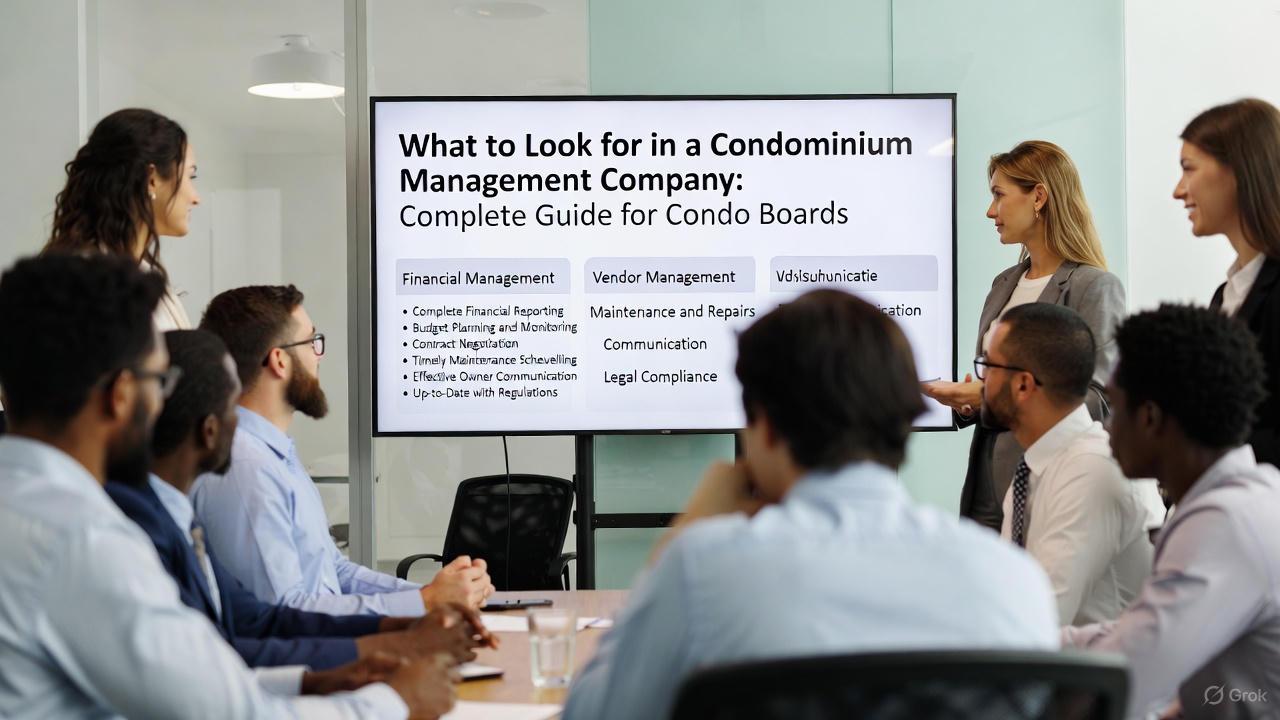
What to Look for in a Condominium Management Company: Complete Guide for Condo Boards
Selecting the right condominium management company is one of the most critical decisions a condo board will make. This choice directly impacts property values, owner satisfaction, financial health, and the overall quality of life in your community. Yet many boards struggle to differentiate between management companies, as most present similar claims about their expertise, service quality, and commitment to client success.
The challenge lies in cutting through marketing language to identify real, substantive differences between companies. While larger firms may emphasize their depth of resources and industry experience, smaller companies often highlight their flexibility and personalized service. However, these surface-level distinctions don't necessarily indicate which company will best serve your specific condominium's needs.
This comprehensive guide provides condo boards with the essential questions, evaluation criteria, and strategic approaches needed to make an informed decision. By understanding what truly matters in condominium management and knowing which questions to ask, boards can identify management companies that will genuinely serve their community's best interests rather than simply accepting the most polished sales presentation.
Understanding the Stakes: Why Management Company Selection Matters
The condominium management company you choose becomes the operational backbone of your corporation. They handle financial management, coordinate maintenance and repairs, ensure compliance with the Condominium Act, facilitate communication between owners and the board, and manage the day-to-day operations that keep your building functioning smoothly. The quality of this management directly affects every aspect of condominium life.
Poor management can lead to deferred maintenance, financial mismanagement, legal compliance issues, declining property values, and community discord. Conversely, excellent management helps maintain property values, ensures sound financial planning, facilitates effective governance, and creates a positive living environment for all owners. The difference between good and poor management can amount to tens of thousands of dollars in property value per unit over time.
Given these high stakes, boards must approach the selection process methodically and thoroughly. Rushing the decision or accepting surface-level assurances can lead to years of problems that are difficult and expensive to correct. Taking the time to properly evaluate candidates and ask the right questions is an investment in your community's future.
Essential Questions to Ask Management Companies
During interviews or the RFP (Request for Proposal) process, asking targeted questions helps reveal substantive differences between companies. These questions go beyond marketing claims to uncover how companies actually operate, what resources they have available, and how they approach the complex challenges of condominium management.
Financial Expertise and Accounting Capabilities
Do you have a CPA on staff? This question is designed to determine whether the company's accounting department has the necessary expertise or if they rely solely on bookkeepers. A Certified Public Accountant (CPA) on staff indicates a higher level of financial oversight and professionalism, ensuring that the condo's finances are managed accurately and transparently.
Financial management is one of the most critical aspects of condominium operations. Your corporation may handle millions of dollars annually, and proper accounting is essential for maintaining financial health, ensuring compliance, and making informed decisions. A company willing to invest in CPA-level expertise demonstrates a commitment to financial accuracy and professional standards.
Having a CPA on staff also indicates that the company is willing to invest in their services at the expense of higher profits. This investment shows they prioritize quality over cost-cutting, which is a positive indicator of their overall approach to management. Companies that rely solely on bookkeepers may be more cost-effective, but they may lack the expertise needed to handle complex financial situations or provide strategic financial guidance.
Follow-up questions might include asking about the CPA's specific role, how often they review financial statements, and whether they're available to consult on complex financial matters. Understanding the depth of financial expertise available can help you assess whether the company can handle your corporation's specific financial needs.
Access to Specialized Expertise
How do you ensure each condo gets the right expertise when they need it? Condominium managers handle a wide variety of issues, from routine maintenance coordination to complex legal questions, major capital projects, and financial planning. This question aims to find out if the company relies on jack-of-all-trades managers or if they have specialized experts available.
While general managers can handle many day-to-day tasks effectively, complex situations often require specialized knowledge. A company with a network of specialists can provide tailored solutions to complex problems, ensuring that your condo gets the best possible advice and service. This might include legal experts for condominium document interpretation, project managers for major capital work, financial analysts for budget planning, or engineers for technical assessments.
If the company does have specialists on staff, it's important to understand how they're brought in to each property and whether there are extra costs involved. Some companies include specialist access as part of their standard service, while others charge additional fees. Understanding this structure helps you assess the true cost of management and whether you'll have access to the expertise you need when problems arise.
A company that can't provide clear answers about specialist access may struggle when your building faces complex challenges. Whether it's a major repair project, a legal dispute, or a financial planning issue, having access to the right expertise at the right time can make the difference between a successful resolution and an expensive problem.
Vendor Selection and Relationships
How do you choose your vendors? This question helps uncover whether the company plans on pushing their own vendors or if they are open to using existing vendors familiar with your building. Vendor selection can significantly impact both the quality of work and the cost to your corporation, making this an important consideration.
A follow-up question could be to ask if vendors need to pay to be on their preferred list. This can reveal potential conflicts of interest and ensure that vendor selection is based on quality and suitability rather than financial incentives. Companies that charge vendors for preferred status may prioritize those relationships over finding the best vendor for each specific job.
Ideally, a management company should evaluate vendors based on their qualifications, experience, pricing, and track record with similar buildings. They should be willing to work with vendors you already know and trust, while also introducing new vendors when they can provide better service or value. A company that insists on using only their preferred vendors may limit your options and potentially increase costs.
Understanding the vendor selection process also helps you assess whether the management company will work collaboratively with your board on major projects. Some companies take a more consultative approach, involving the board in vendor selection, while others make these decisions independently. Knowing their approach helps you understand how much control you'll have over important decisions.
Strategic Planning and Vision
If we hire you, what would your first 3 months look like? What about 6 months? This question is designed to assess the strategic thinking of the company. Are they planning on simply keeping the lights on, or do they have a broader plan or vision for your condo? A detailed and strategic approach in their response indicates that they are proactive and committed to continuous improvement.
During the first few months, a good management company should conduct a thorough assessment of your building's condition, review financial records, evaluate existing contracts and vendors, identify areas for improvement, and develop a strategic plan for addressing both immediate needs and long-term goals. This period is crucial for understanding your building's unique characteristics and establishing effective working relationships.
A company that can't articulate a clear plan for the initial months may not be thinking strategically about your building's needs. They may simply plan to maintain the status quo, which might not address underlying issues or opportunities for improvement. A proactive company will identify areas where they can add value from the beginning, whether through cost savings, improved service delivery, or better financial management.
The six-month timeframe allows you to assess their longer-term thinking. Do they have plans for addressing deferred maintenance, improving financial planning, enhancing communication, or implementing operational improvements? A company with a clear vision for improvement demonstrates that they're thinking beyond just maintaining current operations.
Manager Workload and Attention
How many condos/units will our manager be responsible for? Understanding the ratio of managers to units can give you insight into how much attention your condo will receive. If a manager has too many units to oversee, they may not be able to provide the level of service and attention your building requires.
This question comes down to profit versus quality, and it's a good window into how the company operates and how much they invest in their services. Companies that overload managers with too many properties may be prioritizing profit margins over service quality. While this can make their services more affordable, it may also mean that your building doesn't receive the attention it needs.
For buildings hiring a full-time manager, the question should still be asked about the company's other managers. Even if your building has dedicated management, understanding how the company manages workload across their portfolio helps you assess their overall approach to service delivery. A company that consistently overloads managers may struggle with service quality even for buildings with dedicated managers.
There's no magic number for the ideal manager-to-unit ratio, as it depends on factors like building complexity, age, number of amenities, and the specific services required. However, a company should be able to explain their ratio and justify why it's appropriate for your building. If they can't provide a clear answer or if the ratio seems excessive, it may indicate that service quality could suffer.
Professionalism in Transition
Will you let us speak with a board member of a building where you lost the contract? This is a tough question and not all companies will agree, but the goal here is to learn whether the management company can leave on good terms when things do not go well. Did they hand over corporate documents properly, or did they leave the next company in a mess?
How a company handles contract termination reveals a great deal about their professionalism and integrity. Companies that handle transitions poorly can create significant problems for the incoming management company and the corporation. Poor transitions can result in lost documents, incomplete financial records, vendor relationship issues, and other problems that take time and money to resolve.
Speaking with a former client can provide valuable insights into the company's professionalism and integrity. Even if the relationship didn't work out, a professional company should be able to transition smoothly and leave the corporation in good shape. If former clients report problems with transitions, it may indicate that the company prioritizes their own interests over their clients' well-being.
While not all companies will agree to this request, their willingness to provide references from former clients (even those who terminated contracts) demonstrates confidence in their professionalism. Companies that refuse or become defensive may have something to hide about how they handle difficult situations or contract terminations.
Long-Term Relationship Stability
How long have you had your longest contract for? This question helps you gauge the company's ability to maintain long-term relationships with their clients. Longevity in contracts can be a good indicator of client satisfaction and consistent service quality, especially as board composition changes over longer periods of time.
Long-term relationships are particularly valuable in condominium management because they allow the management company to develop deep knowledge of your building's history, systems, and unique characteristics. This institutional knowledge is difficult to replace and can be invaluable when making decisions about maintenance, repairs, and improvements.
However, long contract duration alone isn't necessarily a positive indicator. Some companies maintain long contracts through inertia rather than excellence, and some buildings may be reluctant to change management even when service quality declines. The key is understanding why contracts have been maintained—is it because of excellent service, or because of other factors?
Follow-up questions might include asking about contract renewal rates, how many clients they've had for more than five or ten years, and what factors contribute to long-term relationships. Understanding their approach to maintaining client relationships helps you assess whether they're likely to be a long-term partner for your corporation.
Financial Planning and Fee Management
What is the average maintenance fee increase for your portfolio this year? While there are many variables to consider, this question helps you understand if the company is organized enough to provide a clear answer. It's also useful to see how they manage financial planning and fee increases across their portfolio, although a lower number isn't necessarily what you're looking for, since there are a lot of variables at play.
The key is how well the company can explain their answer. A company that can't provide this information or gives vague responses may lack the systems and processes needed to track important metrics across their portfolio. This could indicate broader organizational issues that might affect their ability to manage your building effectively.
Understanding how companies approach maintenance fee planning helps you assess their financial management capabilities. Companies that can explain their approach to fee planning, including how they balance owner affordability with building needs, demonstrate sophisticated financial management skills.
However, it's important not to judge companies solely on fee increase percentages. Lower increases aren't necessarily better if they result in deferred maintenance or inadequate reserve fund contributions. The quality of financial planning and the reasoning behind fee decisions is more important than the percentage itself.
Performance Tracking and Accountability
How do you track different metrics or KPIs? Does the company track performance metrics to monitor how well they are managing your building? Most companies operate without a clear plan or metrics to show their performance. A company that tracks and reports on key performance indicators (KPIs) demonstrates a commitment to accountability and continuous improvement.
Effective performance tracking helps ensure that management companies are delivering on their promises and identifies areas for improvement. Companies that track metrics like response times, budget accuracy, maintenance completion rates, owner satisfaction, and other relevant indicators can demonstrate their value and identify areas where they need to improve.
Ask about specific metrics they track, how they measure success, and how they report this information to boards. Companies that can't provide clear answers about performance measurement may not have systems in place to ensure consistent service quality or to identify and address problems proactively.
Performance metrics also help boards hold management companies accountable. If a company commits to specific service levels or performance standards, having metrics to track these commitments ensures that expectations are clear and that the company can be evaluated objectively. This accountability is essential for maintaining a productive management relationship.
Beyond the Questions: Additional Evaluation Criteria
While asking the right questions is essential, boards should also evaluate companies based on other important factors. These include company culture, communication style, technology capabilities, industry reputation, and alignment with your building's specific needs and values.
Company Culture and Values
The culture of a management company significantly impacts how they interact with your board, owners, and vendors. During interviews and site visits, observe how company representatives communicate, whether they listen actively, and if their values align with your board's priorities. A company whose culture doesn't match your community's values may struggle to build the trust and relationships necessary for effective management.
Consider whether the company emphasizes transparency, collaboration, and owner satisfaction, or if they seem more focused on efficiency and cost control. Neither approach is inherently wrong, but alignment between company culture and board priorities helps ensure a productive working relationship. Companies that value the same things your board values are more likely to make decisions that align with your community's goals.
Company culture also affects how they handle difficult situations. When problems arise, will they be transparent and collaborative, or defensive and secretive? Understanding their approach to challenges helps you assess whether they'll be a true partner in managing your building or simply a service provider executing tasks.
Communication Capabilities and Style
Effective communication is essential for successful condominium management. The management company serves as a bridge between the board, owners, vendors, and other stakeholders. Understanding their communication capabilities, preferred methods, and responsiveness helps you assess whether they'll keep your community well-informed and engaged.
Ask about their communication systems, how they handle owner inquiries, what reporting they provide to boards, and how they facilitate communication between different parties. Companies with robust communication systems and clear processes for information sharing are better equipped to keep everyone informed and address concerns promptly.
Also consider their communication style. Do they communicate in ways that are accessible to all owners, or do they use technical language that may exclude some residents? Effective communication requires adapting to different audiences and ensuring that important information reaches all stakeholders in ways they can understand and act upon.
Technology and Systems
Modern condominium management increasingly relies on technology for financial management, communication, maintenance coordination, and document management. Understanding a company's technology capabilities helps you assess whether they can provide efficient, modern service that meets owner expectations.
Ask about their financial management systems, owner portals, communication platforms, and maintenance tracking systems. Companies with integrated technology platforms can provide more efficient service and better access to information for both boards and owners. However, technology should enhance service, not replace personal attention when it's needed.
Also consider whether their technology systems are user-friendly for both board members and owners. Complex systems that are difficult to use may create barriers to effective communication and information access. The best technology is invisible—it works seamlessly in the background while making information and services more accessible.
Industry Reputation and References
While company-provided references are valuable, seeking independent information about a company's reputation provides additional perspective. Talk to other boards, industry professionals, and vendors about their experiences with the company. Industry reputation often reflects years of performance and can reveal patterns that may not be apparent in interviews or proposals.
Consider checking with organizations like the Association of Condominium Managers of Ontario (ACMO) about the company's standing in the industry. Professional associations often have information about member companies' certifications, complaints, and industry involvement. Companies that are actively involved in professional development and industry organizations may be more committed to maintaining high standards.
Also ask vendors and service providers about their experiences working with the company. Vendors who have positive relationships with management companies often provide better service and may be more willing to go the extra mile when needed. Understanding these relationships helps you assess the company's ability to coordinate effectively with service providers.
Red Flags to Watch For
While evaluating management companies, be alert for warning signs that may indicate problems. These red flags don't necessarily mean a company should be eliminated, but they warrant careful investigation and may indicate areas where the company may not meet your needs.
Unrealistic Promises or Guarantees
Companies that make unrealistic promises or guarantees should be viewed with skepticism. Condominium management involves many variables beyond a management company's control, and no company can guarantee specific outcomes like fee reductions, problem-free operations, or other absolute results. Companies that make such promises may be more focused on winning the contract than on realistic service delivery.
Be particularly cautious of companies that promise significant cost savings without understanding your building's specific situation. While good management can identify cost-saving opportunities, dramatic promises may indicate that the company plans to cut corners or reduce service levels to achieve those savings. Understanding how they plan to deliver on promises helps you assess whether their approach aligns with your priorities.
Similarly, companies that guarantee they'll never make mistakes or that they can solve all problems quickly should be viewed skeptically. Honest companies acknowledge that challenges arise and focus on how they'll handle problems when they occur, rather than promising that problems won't happen.
High Staff Turnover
Frequent changes in management staff can disrupt service continuity and indicate underlying problems within the company. While some turnover is normal, excessive turnover may indicate poor working conditions, inadequate compensation, or other issues that could affect service quality. Ask about staff retention rates and how the company handles transitions when managers leave.
High turnover can also mean that your building may experience frequent manager changes, which disrupts the continuity of service and institutional knowledge. Each new manager needs time to learn your building's history, systems, and unique characteristics, and frequent changes mean this learning process is constantly restarting.
If a company has high turnover, ask about their reasons and what they're doing to address it. Companies that acknowledge turnover issues and have plans to address them may be more trustworthy than those that dismiss concerns or blame external factors entirely.
Lack of Transparency
Transparency is essential for effective condominium management. Companies that are evasive about their processes, fees, or performance may be hiding problems or may not have systems in place to provide the information boards need. During the evaluation process, observe whether companies are open about their operations and willing to provide detailed information.
Be cautious of companies that resist providing detailed proposals, refuse to answer specific questions, or become defensive when asked about their practices. Effective management requires open communication and transparency, and companies that aren't transparent during the selection process may not become more transparent after being hired.
Transparency also extends to financial matters. Companies should be able to clearly explain their fee structure, what's included in their services, and what additional costs you might incur. Unclear or confusing fee structures may indicate that the company isn't being straightforward about costs, which can lead to unpleasant surprises later.
Pressure Tactics or Rushed Decisions
Reputable management companies understand that selecting a management company is a significant decision that requires careful consideration. Companies that pressure boards to make quick decisions, offer time-limited deals, or use other high-pressure sales tactics may be more focused on winning contracts than on ensuring a good fit.
Be particularly cautious of companies that claim their offer is only valid for a limited time or that they need an immediate decision. While there may be legitimate reasons for urgency in some situations, most management company selections can and should proceed at a pace that allows for thorough evaluation. Companies that respect your need for careful consideration are more likely to respect your needs throughout the relationship.
Similarly, companies that disparage competitors or make negative claims about other companies should be viewed with caution. Professional companies focus on their own strengths and let their qualifications speak for themselves, rather than trying to win by attacking others.
The RFP Process: Structuring Your Evaluation
A well-structured Request for Proposal (RFP) process helps ensure that you receive comparable information from all candidates and can make an informed decision. The RFP should clearly outline your building's needs, the information you're seeking, and the evaluation criteria you'll use to make your decision.
Developing Your RFP
Your RFP should provide candidates with comprehensive information about your building, including its age, size, number of units, amenities, current challenges, and goals for management. This information helps companies understand your needs and prepare proposals that address your specific situation rather than generic responses.
Include clear instructions about what information you're seeking, the format for responses, and deadlines for submission. Providing a structured format helps ensure that you receive comparable information from all candidates, making evaluation easier and more objective. Consider requesting information about company background, relevant experience, proposed management approach, fee structure, and references.
Also specify your evaluation criteria and how proposals will be evaluated. This transparency helps candidates understand what's important to your board and allows them to tailor their proposals accordingly. Clear evaluation criteria also help ensure that your board makes decisions based on objective factors rather than subjective impressions.
Interview Process
Interviews provide an opportunity to ask detailed questions, assess communication style, and evaluate how well candidates understand your building's needs. Prepare questions in advance and ensure that all board members have an opportunity to participate. Consider including questions about specific scenarios your building has faced or might face in the future.
During interviews, observe how candidates respond to questions. Do they listen carefully, provide thoughtful answers, and demonstrate understanding of your concerns? Or do they give generic responses that don't address your specific situation? The quality of their responses during interviews often reflects the quality of service you can expect.
Also consider asking candidates to present their approach to managing your specific building. This helps you assess whether they've done their homework, understand your building's unique characteristics, and have thought about how they would address your specific needs and challenges.
Site Visits and Reference Checks
Visiting buildings currently managed by candidate companies provides valuable insights into their actual performance. During site visits, observe building condition, talk to board members and owners if possible, and assess whether the management appears effective. While every building is different, site visits can reveal patterns in how companies manage properties.
Reference checks are essential for verifying claims made during interviews and proposals. Contact references provided by the company, but also seek out independent references from other sources. Ask references about both strengths and weaknesses, how the company handles problems, and whether they would hire the company again.
When checking references, ask specific questions about situations similar to those your building faces. Generic questions may not reveal important information, while specific questions help you understand how the company would handle your particular challenges and opportunities.
Understanding Management Contracts
Before finalizing your selection, carefully review the management contract to ensure it protects your interests and clearly defines expectations. The contract should specify services to be provided, fee structure, termination provisions, and other important terms that will govern your relationship.
Service Specifications
The contract should clearly specify what services are included in the management fee and what services incur additional charges. Vague service descriptions can lead to disputes later about what's included and what requires additional payment. Detailed service specifications help ensure that expectations are clear from the beginning.
Review the contract to ensure it includes all services your building needs, from basic financial management and maintenance coordination to more specialized services like project management or legal consultation. Understanding what's included helps you assess the true cost of management and avoid unexpected charges.
Also consider whether the contract allows for service modifications as your building's needs change. Buildings evolve over time, and your management needs may change. A contract that's too rigid may not accommodate these changes, while one that's too flexible may allow the company to reduce services without your agreement.
Fee Structure and Additional Costs
Understanding the complete fee structure is essential for accurate cost comparison and budget planning. Management fees may be structured in various ways, including per-unit fees, percentage of budget, or flat monthly fees. Each structure has different implications for how costs scale as your building grows or changes.
Also understand what additional costs you might incur beyond the base management fee. These might include charges for special projects, additional reporting, after-hours services, or other services not included in the standard fee. Understanding these potential additional costs helps you assess the true total cost of management.
Review the contract for provisions about fee increases. How often can fees be increased, by how much, and with what notice? Understanding these provisions helps you plan for future costs and ensures that fee increases are reasonable and transparent.
Termination Provisions
Termination provisions are important even when you're optimistic about the relationship. Circumstances change, and you may need to terminate the contract for various reasons. Understanding termination requirements, notice periods, and transition obligations helps ensure that you can end the relationship if necessary without excessive difficulty or cost.
Review provisions about what happens upon termination, including document transfer, financial record handover, and transition assistance. Companies that commit to smooth transitions demonstrate professionalism and respect for their clients, even when relationships end. Poor termination provisions can make it difficult and expensive to change management companies if problems arise.
Also consider whether the contract includes provisions for termination without cause, termination with cause, and what constitutes cause for termination. Understanding these provisions helps you assess your flexibility to end the relationship if it's not working, which is an important protection for your corporation.
Making the Final Decision
After completing your evaluation, the board must make a decision. This decision should be based on objective evaluation of how well each candidate meets your criteria, rather than on personal relationships, pressure, or other subjective factors. A systematic approach to decision-making helps ensure that you select the best company for your building.
Scoring and Comparison
Develop a scoring system based on your evaluation criteria to help make objective comparisons between candidates. Assign weights to different criteria based on their importance to your building, then score each candidate on each criterion. This systematic approach helps ensure that important factors aren't overlooked and that the decision is based on comprehensive evaluation.
However, don't rely solely on numerical scores. Consider qualitative factors like communication style, cultural fit, and your confidence in the company's ability to serve your building effectively. Sometimes the company that scores slightly lower on paper may be the better choice if they're a better fit for your specific needs and working style.
Also consider the long-term implications of your decision. While cost is important, the cheapest option may not provide the best value if service quality suffers. Similarly, the most expensive option may not be necessary if a mid-range company can meet all your needs effectively. Focus on value rather than just cost.
Board Consensus and Communication
Ideally, the board should reach consensus on the management company selection. While unanimous agreement may not always be possible, working toward broad agreement helps ensure that the entire board is committed to making the relationship successful. If there are significant disagreements, take time to discuss concerns and ensure that all board members understand the rationale for the decision.
Once a decision is made, communicate clearly with the selected company about expectations, timelines, and next steps. Also communicate with companies that weren't selected, thanking them for their time and providing feedback if appropriate. Professional communication throughout the process reflects well on your board and maintains positive relationships within the industry.
For the selected company, establish clear expectations from the beginning about communication, reporting, decision-making processes, and other aspects of the working relationship. Setting clear expectations early helps prevent misunderstandings and ensures that both parties understand their roles and responsibilities.
Post-Selection: Establishing a Successful Relationship
Selecting the right management company is only the beginning. Establishing a successful working relationship requires ongoing effort from both the board and the management company. Clear communication, mutual respect, and shared commitment to the building's success are essential for long-term success.
The Transition Period
The first few months after hiring a new management company are critical for establishing effective working relationships and processes. During this transition, the board should be actively engaged, providing feedback, asking questions, and ensuring that the company understands your building's unique needs and priorities.
Work with the management company to establish clear communication protocols, reporting schedules, and decision-making processes. The transition period is also an opportunity to address any issues with the previous management company, transfer institutional knowledge, and set the foundation for effective long-term management.
Be patient during the transition, as new management companies need time to learn your building's systems, history, and unique characteristics. However, also be proactive about addressing concerns early, as problems that aren't addressed during the transition may become more difficult to resolve later.
Ongoing Evaluation and Communication
Regular evaluation of management performance helps ensure that the relationship remains productive and that the company continues to meet your expectations. Establish regular review meetings to discuss performance, address concerns, and identify opportunities for improvement. These reviews should be constructive and focused on continuous improvement rather than simply finding fault.
Maintain open communication with the management company about both successes and challenges. Companies that understand what's working well can build on those successes, while understanding challenges helps them address problems before they become serious. Regular, honest communication is essential for maintaining a productive working relationship.
Also ensure that owners have opportunities to provide feedback about management performance. Owner satisfaction is an important indicator of management effectiveness, and understanding owner perspectives helps boards assess whether the management company is meeting community needs. Regular surveys, meetings, or other feedback mechanisms can help gather this information.
Special Considerations for Different Building Types
Different types of condominiums have different management needs, and companies may have varying levels of experience and expertise with different building types. Understanding how a company's experience aligns with your building type helps ensure they can effectively manage your specific situation.
High-Rise Buildings
High-rise buildings present unique management challenges, including complex mechanical systems, elevator maintenance, security concerns, and higher density of residents. Management companies with extensive high-rise experience understand these challenges and have developed systems and relationships to address them effectively.
Ask about their experience with buildings of similar size and age, their relationships with specialized vendors who work on high-rise buildings, and their understanding of the specific maintenance and operational requirements of high-rise properties. Companies without high-rise experience may struggle with the complexity and scale of these buildings.
Townhouse Condominiums
Townhouse condominiums have different management needs than high-rise buildings, often involving road maintenance, landscaping, exterior maintenance, and different insurance considerations. Management companies experienced with townhouse condominiums understand these unique requirements and can provide appropriate service.
Ask about their experience with townhouse communities, their understanding of the specific challenges these communities face, and how they approach management for this building type. Companies that primarily manage high-rise buildings may not have the experience needed to effectively manage townhouse communities.
Older Buildings
Older buildings often require more intensive maintenance, have more complex repair needs, and may face challenges with aging infrastructure. Management companies experienced with older buildings understand these challenges and can help plan for and manage the increased maintenance and repair requirements.
Ask about their experience with buildings of similar age, their approach to reserve fund planning for older buildings, and their relationships with vendors who specialize in working on older properties. Companies without experience managing older buildings may underestimate the complexity and cost of maintaining these properties.
Newer Buildings
Newer buildings may have different management needs, including warranty management, establishing operational procedures, and planning for future maintenance needs. Management companies should understand the specific considerations for newer buildings and help establish effective systems and processes from the beginning.
Ask about their experience with newer buildings, their approach to establishing management systems, and how they help boards plan for future maintenance and reserve fund needs. Companies experienced with newer buildings can help establish strong foundations for long-term building management.
Cost Considerations and Value Assessment
While cost is an important factor in selecting a management company, it should be considered in the context of value rather than as the sole determining factor. The cheapest option may not provide the best value if service quality suffers, while the most expensive option may not be necessary if a mid-range company can meet all your needs effectively.
Understanding Total Cost
When comparing management company costs, consider the total cost of management, not just the base management fee. Additional costs for special projects, extra services, or other charges can significantly affect the total cost. Understanding the complete fee structure helps ensure accurate cost comparison.
Also consider indirect costs that may result from management quality. Poor management can lead to deferred maintenance, inefficient operations, or other problems that cost money to correct. These indirect costs may far exceed any savings from choosing a lower-cost management company.
Similarly, excellent management may identify cost-saving opportunities, negotiate better vendor contracts, or implement efficient processes that save money over time. These savings should be considered when evaluating management company costs, as they may offset higher management fees.
Value Versus Cost
Focus on value rather than just cost when evaluating management companies. A company that charges slightly more but provides significantly better service may be a better value than a cheaper company with lower service quality. Consider what you're getting for your money, not just how much you're paying.
Value includes factors like service quality, expertise, responsiveness, problem-solving ability, and the overall benefit to your building. Companies that provide excellent value help maintain property values, ensure sound financial management, and create positive living environments, which benefits all owners regardless of management fees.
However, also ensure that you're not overpaying for services you don't need. A building with simple management needs may not require the most comprehensive and expensive management services. Understanding your specific needs helps you identify the right balance between cost and service level.
Industry Standards and Best Practices
Understanding industry standards and best practices helps you evaluate whether management companies are providing appropriate service levels and following professional standards. Companies that adhere to industry best practices are more likely to provide consistent, high-quality service.
Professional Certifications and Training
Professional certifications like ACMO2000 and RCM (Registered Condominium Manager) indicate that managers have met education, experience, and ethical standards. Companies that invest in professional development and maintain certifications demonstrate commitment to maintaining high professional standards.
Ask about the certifications held by managers who would work on your building, the company's approach to ongoing training and professional development, and their commitment to maintaining professional standards. Companies that prioritize professional development are more likely to stay current with industry best practices and regulatory requirements.
Also consider whether the company is involved in industry organizations and professional development activities. Companies that actively participate in the condominium management community are more likely to be aware of industry trends, best practices, and regulatory changes that may affect your building.
Compliance and Regulatory Knowledge
Condominium management requires understanding and compliance with numerous laws and regulations, including the Condominium Act, building codes, employment standards, and other applicable legislation. Management companies must stay current with regulatory requirements and ensure that buildings comply with all applicable laws.
Ask about the company's approach to regulatory compliance, how they stay current with legal and regulatory changes, and their experience handling compliance issues. Companies with strong compliance programs help protect your corporation from legal and regulatory problems that can be costly and disruptive.
Also consider whether the company has legal resources or relationships with condominium lawyers who can provide guidance on complex compliance issues. While management companies aren't law firms, having access to legal expertise when needed is valuable for addressing complex compliance questions.
Building Long-Term Success
Selecting the right management company is the foundation for long-term success, but maintaining a productive relationship requires ongoing effort. Regular communication, mutual respect, clear expectations, and shared commitment to the building's success help ensure that the management relationship remains productive over time.
Boards should view management companies as partners in building success rather than simply service providers. This partnership approach encourages collaboration, open communication, and shared commitment to achieving the building's goals. Companies that embrace this partnership model are more likely to go above and beyond to serve your building effectively.
Regular evaluation and feedback help ensure that the relationship continues to meet your needs as your building evolves. As your building's needs change, your management requirements may also change. Maintaining open communication about these evolving needs helps ensure that the management company can adapt their services to continue meeting your requirements.
For condominium boards preparing to select a management company, taking the time to thoroughly evaluate candidates and ask the right questions is an investment in your community's future. By understanding what truly matters in condominium management and systematically evaluating candidates, boards can identify management companies that will genuinely serve their community's best interests.
If you're a condominium board looking for guidance on selecting a management company or need help with your RFP process, contact Brilliant Property Management. Our experienced team can help you understand your options and make an informed decision that serves your community's long-term interests.