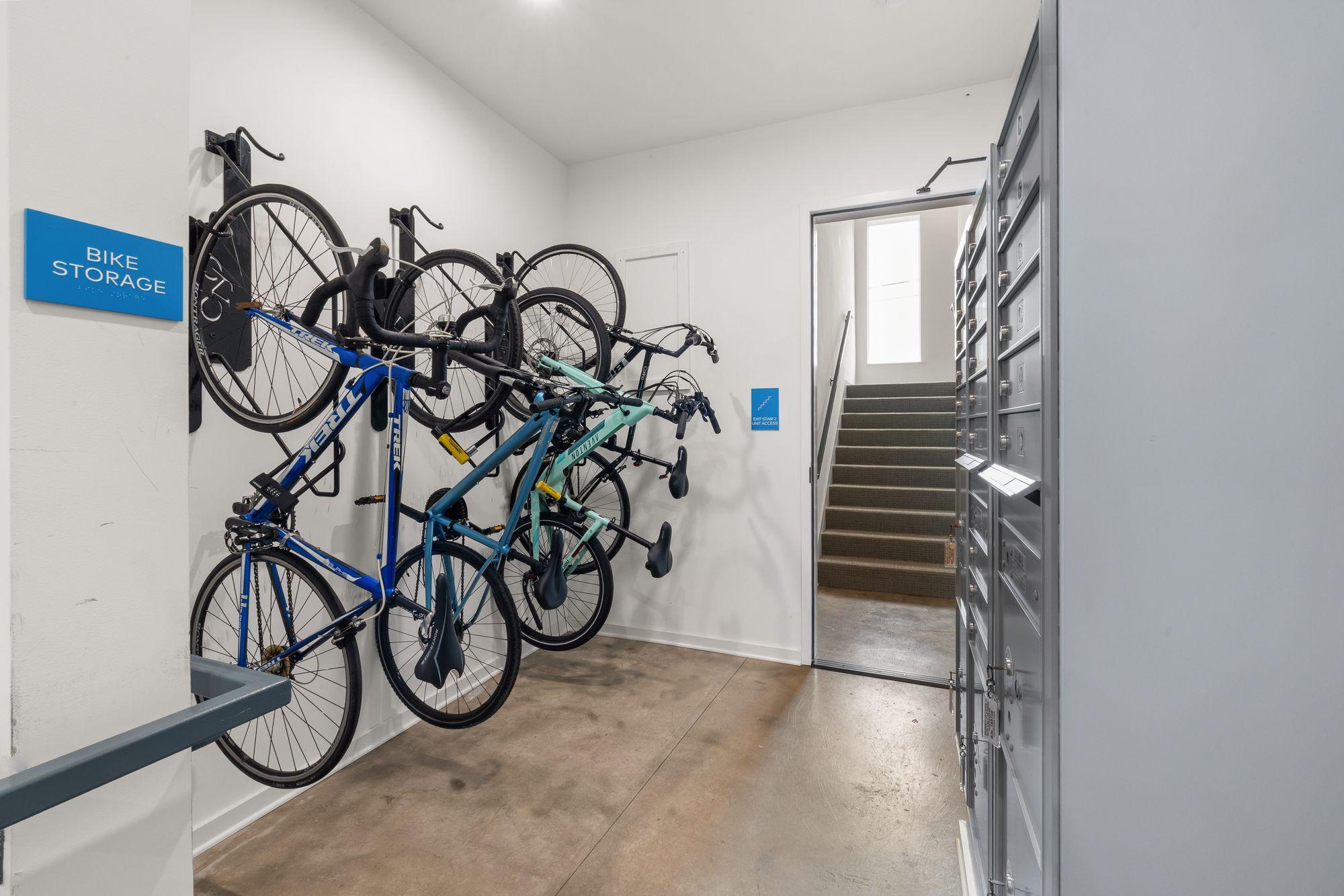
A few years ago, the bike room was one of the quietest spaces in a condominium. Today it is often one of the most contested. Owners want secure storage for bicycles that can cost as much as a used car, residents bring e-bikes and e-scooters through the lobby and up the elevator, and fire officials across Ontario are warning about lithium-ion battery fires in multi-unit buildings. For a condo board, that adds up to a capacity problem, a rules problem and a fire safety problem all at once.
This guide is for Ontario condo boards and directors, with a focus on Toronto buildings. It covers what the Condominium Act, 1998 lets a board do, what the Ontario Fire Code already requires, the Fire Code changes the province has proposed for e-bike and e-scooter batteries, and how to write practical rules for bike rooms, storage and charging.
Why Bike Rooms Have Become a Board Issue
Most Toronto condos were designed with a fixed number of bicycle spaces, usually in a bike room on a parking level or a ground-floor storage area. Demand has grown faster than the space, and the type of equipment has changed. Boards now hear the same complaints again and again:
- Bike rooms full of abandoned bicycles, so residents who ride every day have nowhere to park.
- Bicycles chained to railings, left in corridors or wheeled into lockers that were never meant to hold them.
- E-bikes and e-scooters being charged in hallways, lobbies, storage lockers or from common element outlets.
- Owners asking the corporation to install wall racks, charging stations or a second bike room.
Most of these can be handled with clear rules, consistent enforcement and a realistic plan for the space. The fire safety piece deserves the most attention.
What the Condominium Act Lets Boards Do
Rules under section 58
Under section 58 of the Condominium Act, 1998, a board may make rules about the use of the units, the common elements and the corporation's assets to promote the safety, security or welfare of the owners and the property, or to prevent unreasonable interference with the use and enjoyment of the property. Rules must be reasonable and consistent with the Act, the declaration and the by-laws.
Bike room and battery rules fit squarely within that power, as long as they are reasonable. When the board makes, amends or repeals a rule, it must send owners a notice that includes the rule, the proposed effective date, a statement of their right to requisition a meeting under section 46, and the text of sections 46 and 58. If owners do not requisition a meeting within 30 days of the notice, the rule takes effect the day after that 30th day. If they do requisition a meeting, the rule takes effect if quorum is not reached at the first attempt to hold the meeting, or if quorum is reached and the owners do not vote against it. Our guide to the differences between the declaration, by-laws and rules explains where each type of provision belongs.
The general duty not to create a danger
Section 117(1) of the Act says no person shall, through an act or omission, cause a condition to exist or an activity to take place in a unit, the common elements or the corporation's assets if it is likely to damage the property or cause an injury or illness to an individual. Section 119 requires owners, occupiers and the corporation itself to comply with the Act, the declaration, the by-laws and the rules, and requires owners to take all reasonable steps to make sure their occupiers and invitees comply too.
That matters for e-bikes. A resident who charges a damaged or modified battery beside a unit door is not only breaking a rule, if you have one. Depending on the facts, the conduct may also raise the general prohibition in section 117(1). Boards should get legal advice before relying on section 117 in a specific dispute, because the right forum and remedy depend on the circumstances.
Changes to the common elements
Adding racks, building a second bike room or installing dedicated charging equipment are changes to the common elements, so section 97 applies. A board can make some changes by resolution without notice to owners, including changes it considers necessary for the safety or security of people using the property, or changes that fall under the low cost threshold set out in section 97(2). Other changes require a notice to owners describing the work and its estimated cost, with a 30-day window for owners to requisition a meeting. Larger or more substantial changes can require an owner vote. Confirm which path applies before you commit to a project.
If a single owner wants to install something on the common elements, such as a private wall rack or an outlet, section 98 generally requires board approval and a written agreement that allocates costs and responsibilities, including repair, maintenance and insurance.
What the Ontario Fire Code Already Requires
There is no Fire Code article written specifically for e-bikes today, but several existing requirements in Division B of the Fire Code (O. Reg. 213/07) apply directly to bikes and batteries in common areas:
- Means of egress must be maintained in good repair and free of obstructions (Article 2.7.1.7). A bicycle or scooter parked in a corridor, stairwell or exit lobby can be an obstruction.
- Combustible materials must not be accumulated in or around a building in a quantity or location that creates a fire hazard, and must not be accumulated in a means of egress, service room or service space unless that space is designed for them (Article 2.4.1.1).
- Doors in fire separations must be kept closed when not in use, and the area around the door opening must be kept clear of anything likely to obstruct the door (Article 2.2.3.4). Bike room doors and doors to storage areas are often in this category, and propping them open for convenience defeats their purpose.
Your building's fire safety plan, inspection routine and staff training should already address these points. Our article on fire safety obligations for Toronto condo boards covers the broader duties, and it is worth asking your fire safety consultant or manager to look at the bike room specifically on the next walk-through.
Proposed Fire Code Changes for E-Bike and E-Scooter Batteries
On October 21, 2026, the Ministry of the Solicitor General posted proposed amendments to the Fire Code on the Ontario Regulatory Registry to address lithium-ion battery fire safety. According to the Office of the Fire Marshal's communique, the proposals would introduce requirements to:
- Use and charge lithium-ion batteries in accordance with the manufacturer's instructions.
- Prohibit unauthorized modification of lithium-ion batteries.
- Dispose of lithium-ion batteries safely.
- Prohibit, in residential occupancies, the charging, parking and storing of lithium-ion battery-powered micromobility devices and their batteries in lobbies serving as an access to an exit, in public corridors and in exits.
- Prohibit commercial activities involving these devices or their batteries in residential occupancies, such as charging, storage, sale, service, recycling and disposal, with notice to the Chief Fire Official for commercial activities.
The proposed definition of a powered micromobility device covers motorized bicycles, scooters and other compact personal transportation devices powered by a lithium-ion battery, and excludes motorized wheelchairs, motorized medical scooters, motorized shopping carts and golf carts. The consultation runs until November 16, 2026, and the province has said it expects the changes to take effect in 2027.
These are proposals, not law, and the final wording may change. Even so, they point clearly to where enforcement is heading. A board that adopts sensible battery and storage rules now will not have to scramble later, and it reduces risk in the meantime.
Writing Practical Bike Room and E-Bike Rules
Good rules are short, specific and enforceable. The right content depends on your building, your declaration and the space available, but most boards should consider the following.
Bike room access and capacity
- Registration. Require residents to register bicycles and e-bikes with management, with a tag or decal. Registration makes it far easier to identify abandoned bikes and to contact owners.
- Limits. Set a reasonable limit per unit if demand exceeds space, and consider a waiting list for racks.
- Annual clean-out. Give written notice that untagged bicycles will be tagged and removed after a stated period, store removed bikes for a reasonable time, and document the process. Get legal advice on how long to hold items before disposal.
- Access control. Limit bike room access to registered users through fobs or keys, and remind residents that the corporation does not insure their personal property unless your documents say otherwise.
Where e-bikes and scooters can be stored and charged
- Prohibit storing or charging any bicycle, e-bike or scooter in corridors, stairwells, exits, lobbies and other exit routes.
- Decide whether e-bikes may be kept in the bike room, in lockers or in parking units, and say so expressly. Some buildings designate a separate, ventilated area for e-bikes away from exits.
- Decide whether charging is allowed anywhere on the common elements. If it is, limit it to a designated, approved location. If it is not, say that common element outlets may not be used to charge personal devices.
- Prohibit charging batteries that are damaged, swollen, leaking or modified.
Equipment and battery standards
Toronto Fire Services advises residents to buy devices listed by a qualified testing laboratory, such as UL or ULC, to use only the battery, charger and cord provided or approved by the manufacturer, to charge on a hard surface away from combustible materials, to unplug once fully charged, and never to charge while sleeping or away from home. Its Fire Prevention Week 2026 guidance is a useful plain-language summary to share with residents. A rule can reasonably require certified equipment and prohibit modifications. Be careful about rules that ban e-bikes outright or reach deep inside units; the more a rule restricts what owners do in their own suites, the more carefully it needs to be tested for reasonableness, and the more important legal review becomes.
Mobility devices and accommodation
Keep motorized wheelchairs and medical mobility scooters separate in your rules. The proposed Fire Code definition excludes them, and under the Ontario Human Rights Code a corporation has a duty to accommodate residents with disabilities to the point of undue hardship. Write rules so that a resident who relies on a mobility device is not caught by an e-bike restriction, and handle charging needs for those devices through an individual accommodation conversation.
Thinking About Capacity: Racks, Charging and Electrical Load
If the board wants to add capacity or offer supervised charging, treat it as a small capital project rather than a quick fix. Ask your manager to:
- Have a qualified electrician or engineer confirm available electrical capacity before adding outlets. Many of the same questions come up with car chargers; our guide to EV charging in Ontario condos explains how boards approach load and cost allocation.
- Ask your fire safety consultant whether the proposed location affects the fire safety plan, sprinkler coverage, fire separations or exits.
- Talk to the corporation's insurance broker before installing any shared charging equipment, and ask what the insurer expects.
- Work out the section 97 notice path and cost before committing.
Lockers and parking spaces raise their own questions. Our article on parking and storage locker rules in Ontario condos covers how unit type and exclusive-use designations affect what the board can enforce in those spaces.
Battery Disposal and Incident Response
In Toronto, lithium-ion batteries are household hazardous waste. The City says they must never go in the garbage, Blue Bin or Green Bin, and should be taken to a City Drop-Off Depot or a Community Environment Day. Batteries in chutes or recycling bins can start fires in garbage rooms and collection trucks, so it is worth repeating this in resident notices. Our guide to garbage, recycling and organics in Toronto condos covers chute rules and resident education more broadly.
Boards should also make sure staff and residents know what to do if a battery starts to smoke, hiss, swell or burn. City guidance is to leave immediately, close doors behind you if it is safe, pull the fire alarm, leave by the stairs rather than the elevator and call 9-1-1 once outside. Any incident should be documented and reported to the board and the insurer.
Communicating and Enforcing the Rules
Rules work when residents understand why they exist. Before adopting new rules, explain the fire safety reasons in a newsletter or town hall, share the City's guidance, and give people time to register bikes and move equipment out of hallways. After the rules take effect:
- Have staff check corridors, bike rooms and locker areas on a regular schedule and record what they find.
- Start with a friendly written reminder, then a formal compliance letter that cites the rule and gives a reasonable deadline.
- Apply the rules consistently. Selective enforcement undermines them quickly.
- Get legal advice before removing items from a unit or exclusive-use area, or before charging enforcement costs back to an owner.
Where a hazard is immediate, such as a battery charging in an exit or a device that is visibly damaged, staff should follow the fire safety plan and escalate right away rather than waiting for the letter process.
A Short Checklist for Boards
- Walk the bike room, lockers, corridors and garage with your manager and note where bikes and scooters are actually kept.
- Review current rules for bicycles, storage, charging and common element outlets.
- Draft or update rules on registration, storage locations, charging, certified equipment and modifications, with a carve-out for mobility devices.
- Send the section 58 notice and plan resident communication.
- Schedule an annual bike room clean-out with written notice.
- Brief staff on incident response and how it fits the fire safety plan.
- Watch for the final version of the Fire Code amendments and update rules if needed.
How Brilliant Property Management Can Help
Bike rooms and battery safety sit where rules, fire safety and day-to-day operations meet, which is exactly where a good manager earns their fee. Our condo property management team in Toronto helps boards draft practical rules, run inspections and clean-outs, coordinate with fire safety consultants, electricians and insurers, and communicate changes to residents. You can see the full range of our condominium management services, or, if your board is reviewing its management arrangements, request a proposal.
Frequently Asked Questions
Can an Ontario condo board ban e-bikes?
A board can make reasonable rules under section 58 of the Condominium Act to promote safety and prevent unreasonable interference, such as limiting where e-bikes are stored and charged and requiring certified, unmodified batteries. An outright ban, especially one that reaches inside units, is more likely to be challenged as unreasonable. Get legal advice before adopting broad restrictions.
Can residents keep bikes in the hallway?
Generally no. The Ontario Fire Code requires means of egress to be kept free of obstructions, and most condo rules prohibit storing personal items in corridors. The province has also proposed Fire Code changes that would prohibit charging, parking and storing e-bikes, e-scooters and their batteries in public corridors, exit lobbies and exits in residential buildings.
Are the new Fire Code rules on e-bike batteries in force?
Not yet. The amendments were posted for consultation on October 21, 2026, the consultation closes November 16, 2026, and the province has said it expects them to take effect in 2027. Final wording may change, so check the current Fire Code before relying on any specific requirement.
This article is general information about Ontario condominium practice and is not legal advice. Consult a qualified condominium lawyer, your fire safety consultant and your insurer about your corporation's specific circumstances.